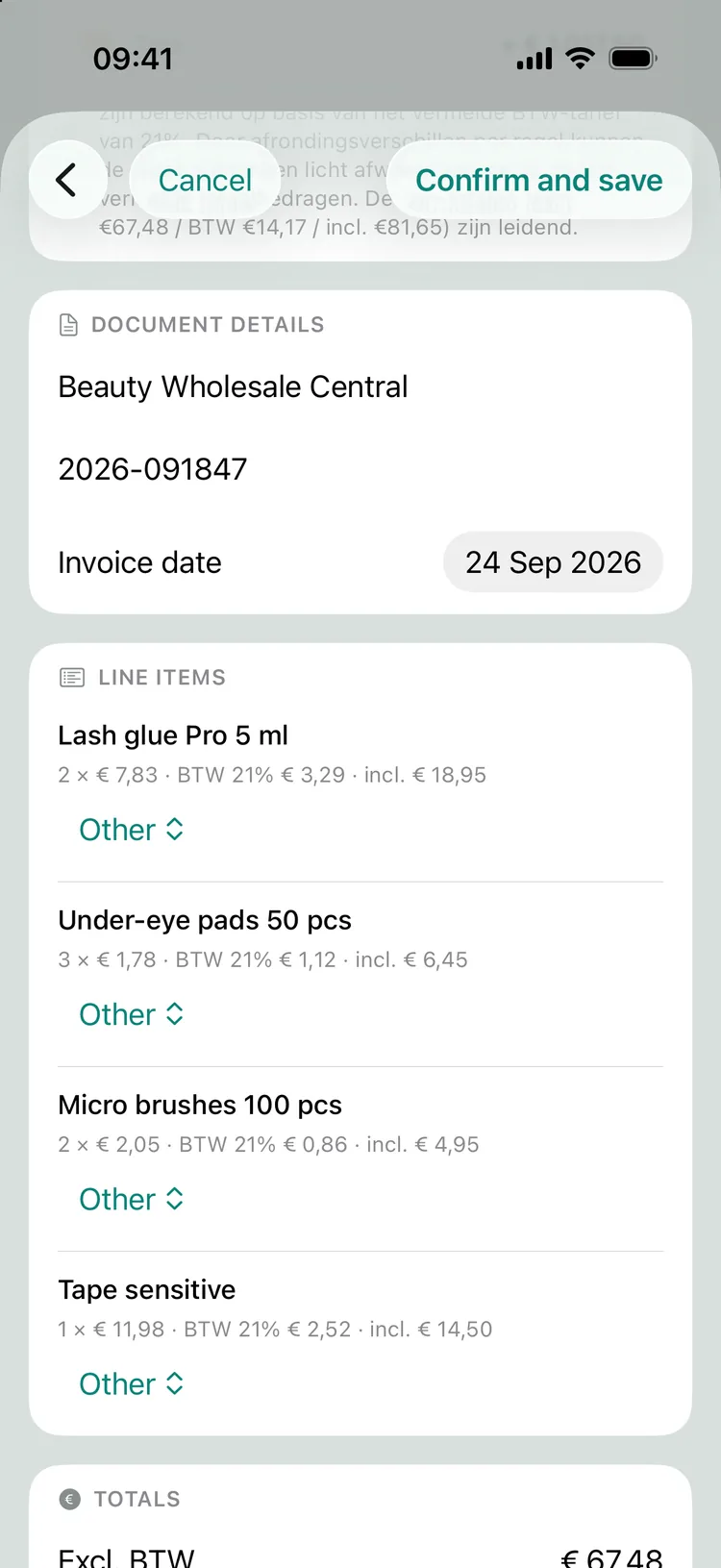
As a chair renter you run a business, and a business owner keeps track not only of their revenue but also of their costs. Every business expense you record lowers your taxable profit - and with it the tax you pay. A saved receipt for €120 of colour products lowers that profit by €120; lose the receipt and you pay tax on it. Lost receipts and invoices are money left on the table. It pays to turn it into a small, regular routine.
This page gives you the practical basics: what to keep, for how long, how BTW (Dutch VAT) on your purchases works, and how to keep the tracking light. ZumFlo is a tool to help with your bookkeeping, not a tax adviser - for your specific situation, your accountant or the Dutch Tax Administration (Belastingdienst) is the source.
What do you need to keep, and for how long?
In the Netherlands, your records are subject to a seven-year retention requirement. That means you keep all receipts, purchase invoices, bank statements and statements relating to your business for seven years. For records relating to real estate, it is even ten years.
A digital copy is allowed, as long as it is complete and legible. In practice: photograph or scan the receipt, store it digitally, and you no longer need the paper version. That saves you a shoebox - and you can always find everything again.